Spencer added to Mets' outfield
January 29, 2004 - The New York signed free-agent outfielder to a one-year deal and invited him to spring training as a non-roster player.
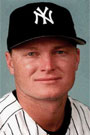 Spencer For Hire!
He spent the first five years of his career in New York with the Yankees, winning three consecutive World Series titles with the team (1998-2000). Overall, Spencer played in 25 post-season games with the Yankees.
"New York holds a lot of great memories for me," Spencer said. "That's where I got my start in the big leagues. I'm looking forward to competing for an outfield spot in spring training."
In his six-year career, Spencer has batted .260 with 55 homers and 216 RBI over 464 games with the Yankees.
Mets sign free agent infielder Todd Zeile
January 28, 2004 - The New York Mets announced today that they have signed free agent infielder Todd Zeile to a one-year, one million dollar contract. Zeile can earn an additional $500,000 in performance bonuses based on plate appearances.
Reports say Mo Vaughn has retired
January 26, 2004 - Mo Vaughn is facing up to life after baseball. The Boston Globe reports that Vaughn has all but announced his retirement from the game, saying as much at a banquet Friday night thrown by the Northeast League's Brockton Rox, where he was guest speaker.
Mets deal Cerda to Kansas City
January 26, 2004 - The Mets alleviated some of the overcrowding in their bullpen on Monday, dealing southpaw Jaime Cerda to Kansas City in exchange for right-hander Shawn Sedlacek. The move also frees up a spot on New York's 40-man roster for Todd Zeile, who is expected to sign this week.
Duquette takes high road on Reed
January 24, 2004 - Free-agent pitcher Rick Reed turned down a chance to rejoin one of his former teams in favor of another, according to his agent, which precipitated an exchange of words between the agent and Mets general manager Jim Duquette.
'Kazmania' sweeps midtown Manhattan
January 21, 2004 - It was 25 degrees in Manhattan on Wednesday, but the hundreds of fans lining the sidewalk didn't seem to mind. The prospect of waiting two-plus hours in the freezing cold to meet the Mets' new shortstop, Japanese star Kaz Matsui, was enough to keep them warm.
Looper confident with Mets
January 21, 2004 - Braden Looper hasn't had a chance yet to really work with Mets pitching coach Rick Peterson on a personal basis. Yet, when looking ahead to the 2004 season, Looper points to Peterson as one of the reasons to expect big things from him this season.
Rested Piazza joins Winter Caravan
January 20, 2004 - Despite the bevy of new players and new story lines surrounding the Mets in 2004, it was a familiar face that continued to dominate the scene on Tuesday afternoon at Grand Central Station. Mike Piazza was on hand as the club kicked off its annual Winter Caravan.
Garcia will undergo physical
January 15, 2004 - Karim Garcia appears in line to be the Mets' new right fielder. Responding to speculation, the Mets on Thursday confirmed negotiations with the outfielder. Furthermore, a statement from the club affirmed Garcia will "undergo a physical examination early next week."
Kazmir's thoughts turn to Spring
January 12, 2004 - Spring Training doesn't begin for another month, but it's already on Scott Kazmir's mind. Former first-round pick Kazmir, who will turn 20 on Jan. 24, will participate in his first Major League Spring Training, and have his first real chance to show manager Art Howe what he can do.
Guerrero turns down Mets' offer
January 10, 2004 - The Mets knew from the outset that landing Vladimir Guerrero would be a long shot. On Saturday, Guerrero's representatives told Jim Duquette that the slugger was turning down a deal that would have guaranteed him $30 million over three seasons.
Vaughn will not play for Mets in 2004
January 8, 2004 - During a Thursday conference call with the New York media, Mo Vaughn announced that he won't be playing in 2004 -- stopping short, however, of saying he was retiring. Vaughn and the Mets have come to an agreement that he would be physically unable to play this year.
Hernandez slips in Hall vote
January 6, 2004 - Awards and milestones marked the career of former Met Keith Hernandez, but one he has not reached is the distinction of being known as a Hall of Famer. In his ninth year on the ballot, Hernandez on Tuesday finished 18th out of 32 eligible players for induction.
Mets to introduce Looper on Tuesday
January 5, 2004 - Braden Looper passed his Monday-morning physical, making his status as the newest New York Met official. The organization's new closer will be introduced to the media on Tuesday afternoon during a press conference in Port St. Lucie, where the team is holding its mini-camp.
Tug McGraw dies at 59
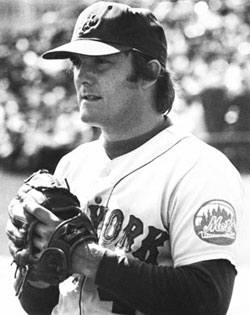
January 5, 2004 - The snapshots that come to mind when reminiscing about Tug McGraw's 19 years in the Major Leagues are vivid. Talk to fans in New York and there's the feisty closer, slapping his glove on his thigh, screaming about how "You Gotta Believe" while exhorting his team to reach what seemed like Herculean heights. Talk to fans in Philadelphia and there is McGraw, jumping off the mound at Veterans Stadium, sealing the World Series for the Phillies, ending decades of heartbreak.
 Tug McGraw
McGraw died of complications from brain cancer. He was 59. The disease ravaged his body but never seemed to rob him of his spirit. And it's that spirit that had Ron Swoboda, one of McGraw's oldest and closest friends, wrestling with his emotions.
Swoboda and McGraw came up together as rookies with the Mets in 1965, sharing a house not too far from Shea Stadium with Danny Riley, the man who was the original Mr. Met mascot. The three young men enjoyed the city, enjoyed the game and enjoyed life and that's what Swoboda chose to focus on when he learned of his friend's death. "He was the first guy from California that I ever spent time with," Swoboda said. "He was always a bright light in a room. Of all the people I played with, he was the guy I cared about the most. I was lucky enough to play with some pretty good people but Tug was the one I cared about the most and it was just because of him being Tug. "We were rookies together and we had such a complete sense of naivetł when we walked into New York. To be so awed and so uncomprehending about everything we did. I remember the times we had and the stuff we did like it was yesterday."
Swoboda went to visit McGraw last month in Philadelphia at a luncheon. He knew his friend didn't have long but was hopeful that "he could hang on just a little longer." "He seemed to have good news at that time but this isn't one you beat," Swoboda said. "If you can buy some time, you're a lucky fellow. Maybe it's good that he didn't linger any longer." McGraw had been fighting the cancer for almost a year, nearly succumbing to the disease last spring. But he battled back through a grueling rehabilitation after doctors removed a pair of tumors from his brain. He made a few appearances during the season, first at Veterans Stadium in May and then again at Shea Stadium in August to celebrate the 30th anniversary of the club's 1973 National League pennant. "On behalf of the entire Mets organization we send our condolences to the McGraw family," Mets chairman and chief operating officer Fred Wilpon said. "We lost a piece of Mets history tonight. Tug was a battler on and off the field. We know how hard he fought this disease. He'll be sorely missed by all."
He was 47-55 with 86 saves over during his nine seasons in New York but the year that cemented his legacy was '73 when his rally cry of "You Gotta Believe" ignited the team and brought them to within one game of a World Series crown. His best season with the Mets, however, actually came in 1972 when he won eight games, saved 27 others and posted a 1.70 ERA. McGraw seemed to be at his best in the postseason, winning titles with the Mets in '69 and later with Philadelphia in 1980. He was 4-5 with six saves, posting a 2.24 ERA in 26 playoff and World Series games. "Any time you hear of anyone dying, specifically from the 1969 team, it leaves a huge hole in my heart," said Mets radio broadcaster and native New Yorker Howie Rose. "When you think of Tug, aside from all the animation and playful histrionics, you think of the prototype for what used to be called a fireman. He'd come into games, sometimes as early as the seventh inning and pitch the eight and pitch the ninth and still manage to throw 100 or more innings every year.
"That's what the art of being a relief pitcher was about and Tug typified what it meant to get into trouble and then pitch his way out. That whole business about him -- slapping his glove on his thigh -- wasn't because he got a save with a three-run lead in the ninth. It was because he got into trouble and worked his way out. It was tough news to hear. I feel the way I felt when Tommie Agee died and when Gil Hodges died 32 years ago."
Swoboda viewed McGraw in the same light. "It always seemed like he would operate on the edge of chaos," Swoboda said. "Just look at the way he pitched. It was almost liked he needed trouble to function. He had to do this tight-wire act but he the ability to get through it. He was a special guy and this one hurts a lot."
Mets captain John Franco is also a New York native and grew up idolizing McGraw. It seemed only fitting since much of Franco's career resembled that of McGraw's, a pitcher making trouble for himself only to get out of it a few batters later. Franco even wears No. 45 in honor of McGraw.
"He was my childhood hero," Franco said. "When Mike Piazza came to the Mets a couple of years ago, I took Tug's number to honor him. Growing up in Brooklyn, I was a Mets fan mainly because of him. To me he was the essence of what a relief pitcher was all about. I'll never forget a couple of years ago when the team honored me after my 400th save. He rode in from center field on a motorcycle to greet me on the mound. He was one of a kind."
Jerry Koosman had the opportunity to play with McGraw twice, first with the Mets and then at the end of both their careers in Philadelphia. They remained close throughout the years. "I feel grief and celebration," Koosman said. "Celebration because I was privileged to know him and play with him. We lost a guy way too early in life. He was energetic and enthusiastic on and off the field. Even when you were just sitting there alone, talking to him, he was very positive and always looked to see how he could make things well. "And when I came back to play for the Phillies, it was like old home week. It was a real reunion. We had a lot of good times in that clubhouse. It was a great reunion after all the time we spent together." Added Tom Seaver: "Tug McGraw was one of the great characters of the game of baseball. He just had a joy for life and living. But what people sometimes overlook because he was always happy go-lucky was what kind of competitor he was on the mound. No one competed with more intensity that he did."
